Follow Me on Pinterest

Monday, July 13, 2015

Ronda


by Robert Bovington


Ronda is interesting. Apart from being one of the most attractive towns in southern Spain, it is famous for smuggling, banditry, hunting and bullfighting.


Ronda - Puente Nuevo © Robert Bovington

The town is located in one of the most dramatic locations in Europe -perched 750 metres above sea level, on an inland plateau, sliced in half by the 100-metre deep Tajo gorge. The Puente Nuevo spans the gorge and connects El Mercadillo, the new part of the town with La Ciudad, the old part.

The views from the bridge and the nearby Alameda Gardens are breathtaking. In fact, the whole town is a photographer's dream - or a nightmare if there is insufficient film or lack of space on the digital camera's memory card. 


Palacio de Marqués de Salvatierra   
© Robert Bovington


Throughout Ronda there are delightful buildings like the 'Palacio de Mondragón' and the Casa del Marqués de Salvatierra'.


Like many Andalucian towns, Ronda has quite a bit of history. It occupies the site of an ancient Iberian settlement and was known in Roman times as Acinipo. Between the 8th and 15th centuries it was occupied by the Moors and the Roman Catholic monarchs Ferdinand and Isabella reconquered it in 1485. Ronda has also been the stronghold of various other peoples - like bandits! Highwaymen roamed the nearby mountains in the 19th century, robbing wealthy tourists headed for Ronda on their 'Grand Tour of Europe'. Smugglers too, frequented the town and some believe that Ronda may have been the supposed location of the third act of Bizet's 'Carmen'. Whether that is true is open to question but one undisputable fact is that Ronda is the cradle of bullfighting. 

Puente Nuevo and Tajo Gorge 
© Robert Bovington

Enough of the history lesson - let's explore Ronda! There is so much to see it is difficult to know where to start. Perhaps it is best to begin at the Puente Nuevo. The bridge is hardly as new as its name implies - it was built over 200 years ago! It is the focal point of the town. It is a masterpiece of architecture and engineering but it took 42 years to build and special machines had to be invented to raise the huge solid stone blocks from the bottom of the gorge. Various vantage points on the bridge provide spectacular views of the gorge far below.

The northern side of the Tajo gorge is the new part of the town, the area known as El Mercadillo. It comprises a warren of streets with bars, restaurants and shops. The Plaza de Toros and the Alameda Gardens are also located there - only a few yards from the bridge. Ronda's bullring, in the Plaza de Toros, is the oldest in Spain. It is quite splendid. The neo-classical interior comprises two storeys with Tuscan columns. There is also a bull-fighting museum and, every September, the Goyesque bullfights take place in the bullring. The three-day feria y fiestas de Pedro Romero were inspired by the great friendship that existed between Francisco de Goya and Pedro Romero, the great bullfighter - if one can call someone who slaughtered over 6000 bulls great! Nonetheless, he is regarded as the father of modern bullfighting. A little further on, there are the Alameda Gardens which are not only delightful but which also provide further breathtaking views of the countryside far below. 

On the southern side of the Puente Nuevo is La Ciudad. Its cobbled streets contain a mix of whitewashed houses and grand Renaissance mansions. It was the old Moorish market area and, historically, the most important part of Ronda. There are numerous historical buildings and fine museums here, so let's start with the Convent of Santo Domingo since it is next to the bridge. The Catholic Monarchs founded the building following their reconquest of the city on May 20, 1485. 

Mina stairs in the House of the 
Moorish King © Robert Bovington

Not far away is 'La Casa del Rey Moro' - allegedly the house of a Moorish King - hence its name. However, the current building is an 18th century palace with beautiful gardens designed by Forestier, the famous French garden designer. Perhaps the palace has been built on the site of a former building because, according to legend, this place was the residence of King Al-Mutadid who allegedly drank his wine from the skulls of his enemies. Inside there are steps down to the foot of the gorge. Now these are Arabic. The 14th century Mina stairs was built by the Moors to prevent water blockades in times of war. The steps were sculpted out of the rock and, according to various guidebooks, there are meant to be 365 of them. Well, on my visit, I counted only 299! That was enough! Returning to the top quite exhausted, it was with relief that I rested - in the delightful gardens of the mansion.
A Gateway to Ronda 
© Robert Bovington

A little further on, is the Arco de Felipe V - King Philip V's Arch - that leads to the Puente Viejo or old bridge. Why is it called that? The new bridge is over 200 years old and admittedly the Puente Viejo is older still but the third bridge that crosses the Río Guadalevín is even older - the Puente Arabe was built in the time of the Moors. Alongside the Arco de Felipe V, there is an attached stone chair known as the Sillón del Moro - the Moor's Chair.

Not far from the arch is the Arab bridge and also the Baños Arabes. These Arabic baths date from the 13th century and are the best preserved in Spain. 

In Calle Marqués de Salvatierran are a number of notable buildings. Capilla de la Santa Cruz stands at one end of the street and next door is one of the finest houses in Ronda, the Palacio de Salvatierra. It was built in 1784 and boasts an exquisite wrought iron balustrade, which is almost as decorative as the façade of the house. The old Marqués must have been important to have both the house and the street named after him! 

At the other end of this street is the Minarete de San Sebastián. It is the only remnant of the old 14th-century Nasrid mosque that stood on this site. There are many religious buildings in the city and quite a few in this area - like the Iglesia de Santa María la Mayor which was built on the ruins of Ronda's main mosque. The church is a mix of Gothic, Renaissance and Baroque styles. There are also Arabic features - the minaret that has been converted into a bell-tower and the remains of the original mihrab. 


Santa María la Mayor  © Robert Bovington


There are many religious buildings in Ronda. In fact, there is so much to see that visitors will need several days in the town to do it justice. However, there are still plenty of fine monuments within easy walking distance of the Church of Santa María. Opposite, on the opposite side of the Plaza de la Duquesa de Parcent, are a group of religious buildings - the Convento de las Clarisas, the Iglesia y Convento de la de Santa Isabel de los Angeles and the Iglesia y Convento de la Caridad. In the same square is the Casa Consistorial, which was a military headquarters in the 18th century.


Ronda - Mondragon Palace 
© Robert Bovington

By far the most attractive building in Ronda is the Mondragón Palace. It has Gothic and Renaissance features as well as some of the original Moorish mosaics. Built in the 14th century, it was formerly a Moorish residence. The Catholic Monarchs, Ferdinand and Isabel, also lived there for a while. Nowadays, it houses the Museum of Ronda and the Serrania.

There are several interesting museums in the town. Not far away, in Calle Armiñan, is the Museo Historico-Popular del Bandolera - the Bandit Museum. In this same street are two other museums the Lara Museum and the Museum of Hunting. Calle Armiñan leads down to the barrio of San Francisco - another old part of town. This street has lots of shops, which is normally be bad news for me when I am with my wife. However, I particularly enjoy exploring the dark recesses of some of the shops containing as they do old furniture, bric-a-brac and many items to do with hunting - old weapons and heads of wild boar! 

I have only covered a small area within reasonable walking distance from the Puente Nuevo. There are many other interesting churches, palaces, museums as well as breathtaking views within Ronda. There is even an old hostel, the Posada de las Animas where Cervantes allegedly stayed. 

Ronda is one of my favourite places and whenever I visit the Costa del Sol, I always head for the town perched above the Tajo Gorge. 
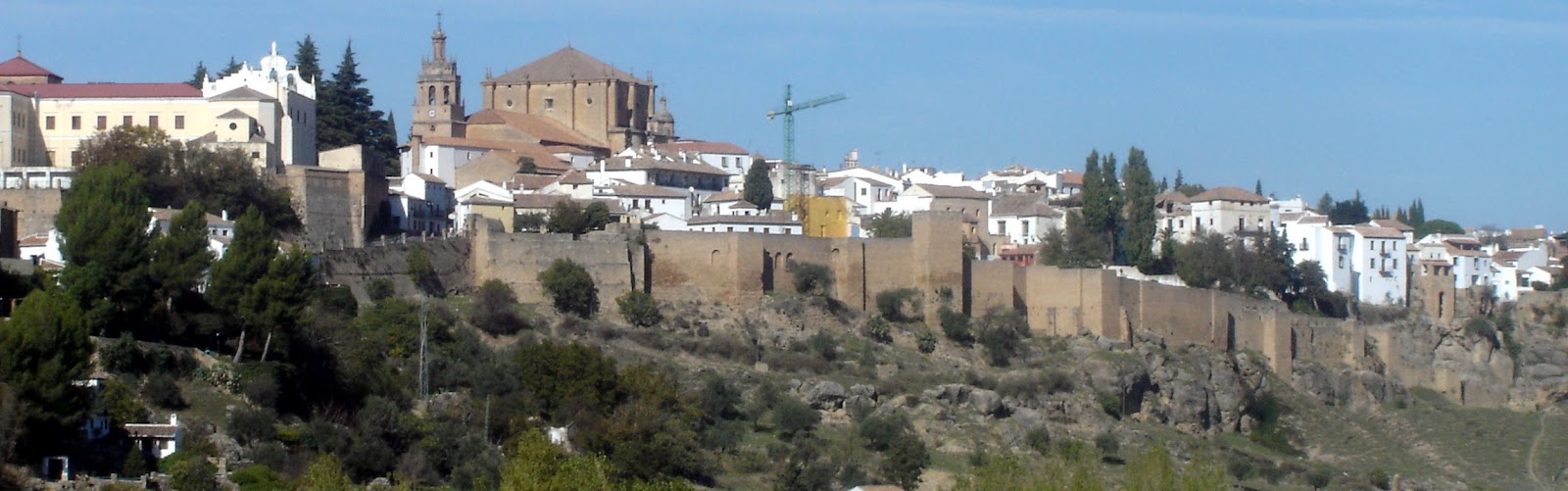

Ronda panorama © Robert Bovington
Robert Bovington 
Roquetas de Mar

more blogs by Robert Bovington...


"Photographs of Spain"
"postcards from Spain"
"you couldn't make it up!"
"a grumpy old man in Spain"
"bits and bobs"
"Spanish Expressions"
"Spanish Art"
"Books About Spain"


www.tablondeanuncios.com


Wednesday, July 8, 2015

Parque Natural Cabo De Gata-Níjar

by Robert Bovington

In the south of Spain, a few miles east of Almería, there is a delightful area that offers miles of unspoilt beaches with secluded coves, sand dunes and much more within a protected coastal reserve. It is the Cabo de Gata, a natural park that I think is quite splendid. It is one of my favourite areas in the province of Almería. 

Cabo de Gata - Las Salinas © Robert Bovington

It is a nature lover's delight. There are thousands of different species there including the pink flamingo and the rare Italian wall lizard. There are eagles, kestrels, puffins, cormorants, oystercatchers and storks. The extraordinary wealth of wildlife is unbelievable. There are some species that are unique to the park. This includes the dragoncillo del Cabo, which flowers all the year round. Europe's only native palm tree - the dwarf fan - is to be found here. In the sea, there are bream, grouper, prawn and squid. There are hundreds of species of seaweed, which are home to the many varieties of crustacean, mollusc and fish.
Perhaps the reason for the great variation in wildlife is due to the diverse habitats in this natural park. The 71,500 acres of the Cabo de Gata is volcanic in origin and comprises coastal dunes, steep cliffs, spectacular beaches, salt marshes, saltpans, arid steppe, dry riverbeds and a substantial marine zone. It is probably this ecological diversity that has led to the park being designated a UNESCO biosphere reserve.
As well as the spectacularly varied landscape, there are also scattered settlements of whitewashed, flat roofed houses and delightful little fishing villages.
One of the things I like about the natural park is that man's intervention can scarcely be detected in this area. There has been some development but it has mostly been confined to the existing settlements. 
San José used to be a small fishing village. Nowadays it is a tourist village but it has not been spoiled too much. 

San José © Robert Bovington
La Isleta del Moro - only a cluster of fishing huts and houses a few years ago - is undergoing some development. Apartments are being built but they appear to be tasteful and their white façades blend in with their surroundings. Other villages have also been expanded slightly.

La Isleta del Moro © Robert Bovington
Between Los Albaricoques and Rodalquilar is a cluster of ruined buildings. The largest one is known as the 'cortijo del fraile'. A notice outside referred to it as a typical example of a farmhouse. However, that is only part of the story.
The famous Spanish author, Federico García Lorca used it as the setting for his chilling play 'Blood Wedding'. It was no coincidence. It is allegedly based on real life events. It is said that in 1928, a tenant farmer lived there. Apparently, he offered a large dowry to the younger of his two daughters. This angered the elder sister. A conspiracy was hatched whereby her brother-in-law would offer marriage and split the dowry with the elder sister and her husband. However, on her wedding day, the bride attempted to run away with her cousin, planning to return after the marriage was consummated to claim the dowry. As the newlyweds set out at night, they met with the elder sister and her husband. The cousin was shot in the head and the bride left half-strangled. The sister and her husband were imprisoned and the bride lived as a spinster. Apparently, she died quite recently.
The building has also been used for a number of spaghetti westerns including 'The Good the Bad and the Ugly'.

Cortijo del fraile © Robert Bovington

The road between the 'cortijo del fraile' and Rodalquilar is a bit rough but the necessary slow driving enables the traveller to enjoy the scenery. It is quite a pleasant sight, driving along this road with the yellow flowers of the pita plant silhouetted against the 'Almerian Blue' sky and the low mountains in the distance, especially on my last visit , when I observed lots of hoopoe flitting from plant to plant.

Rodalquilar - old gold mine workings © Robert Bovington

This part of Spain has always had an abundance of raw materials and this area of the Cabo de Gata has been extensively mined for 2000 years. The Romans extracted silver here. Later 'lead fever' took hold in the middle of the 19th century. However, the golden years for Rodalquilar followed the discovery of gold around 1880. At the beginning of the 20th century, a British company acquired the mining rights and, under the name 'Minas de Rodalquilar', started actively mining the precious metal. They built the millstone in which 900 tons of rock was ground day by day. Rodalquilar, with its electricity supply and its tennis courts and other luxuries was the envy of the other Andalucian villages.
By the late 1930s, the British company had extracted 2,000 kg of gold and following the end of the Spanish Civil War; the mines were handed over to the Spanish government. In 1956, a second golden age came to Rodalquilar. Around 500 men from faraway countries arrived to seek work in the mines and consequently 4000 kg of gold was extracted, together with 165,000 kg of silver. The village had struck it rich. Among the new buildings erected were schools, a cinema, and a casino. This was not to last. In 1966, Spain's only gold mines were closed down. This could have led to Rodalquilar becoming a ghost town. In fact, it very nearly did so, but probably due to the protected status of the Cabo de Gata, some of the old houses have been restored. 
We walked along to a viewing platform in order to look down on the old mine workings. It was a pleasant enough view. It was not so much the dilapidated buildings that made the panorama attractive, though they were interesting enough, the Rodalquilar valley beyond the mining area looked splendid - especially with the white houses of the town further on and the range of mountains in the distance.
Driving downhill towards the town, the dusty track becomes a properly made up road with palms and adelfa bushes lining both sides. Near the old disused buildings is an Information Centre where visitors can obtain maps and guides to the area. There is a botanical garden nearby.
The highlight of any trip to the Cabo de Gata is to visit one of the many delightful beaches. One of my favourites is the Playa de Playazo. This long unspoiled beach is only a short distance from Rodalquilar. On the way there, visitors can take a detour to view another ruin, this time a small castle called 'Castillo San Ramón', a defensive fort from the 18th century.
The Playa de Playazo enjoys an exceptional environmental setting. Incidentally, the beach is also known as the Playa de Rodalquilar due to its close proximity to the town.

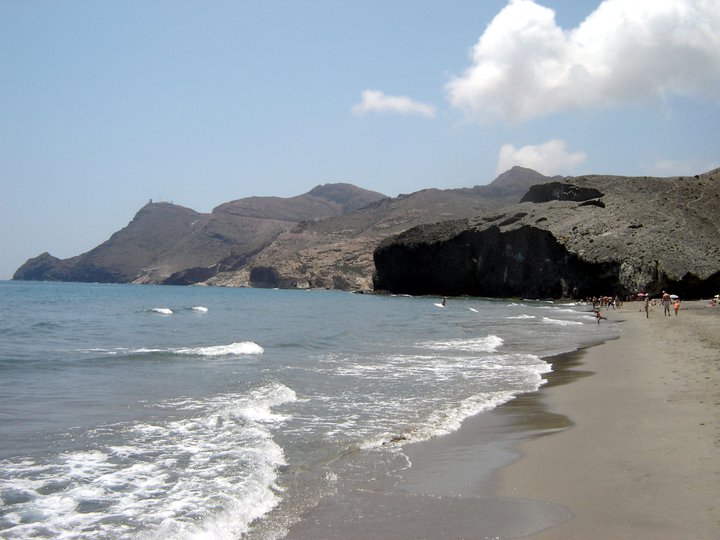
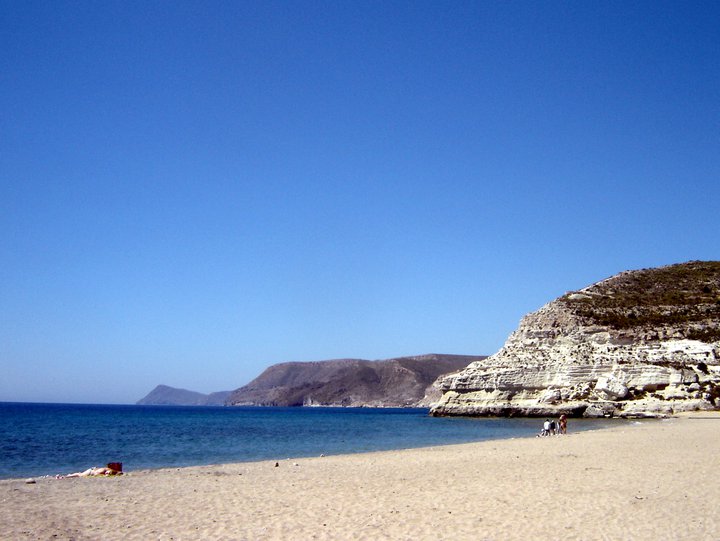
Cabo de Gata © Robert Bovington

When I visit, I look for a delightful little cove. It is only big enough for three or four people - a tiny private beach. To reach it one has to either jump seven or eight feet from the cliff-side to the beach or swim underwater through the little tunnel in the rock face. It is a perfect little haven for a seaside picnic. At the back of the beach is a shallow cave that provides protection from the fierce Almerian sunlight.
Agua Amarga, a small coastal town that is quite pretty. There are the traditional single story whitewashed buildings, many festooned with flowers especially bougainvillea.
Agua Amarga
© R Bovington
Las Negras gets its name from the shape and colour of the black hill that one can observe from the beach. It was formed by the solidification of volcanic lava.
Las Negras has character - and hippies! I was not impressed on my first visit several years ago. A group of hippies sat on the pavement playing guitars and flutes. A girl in a long floral dress with bare dirty feet was juggling. Others were selling jewellery on the promenade.
On a recent visit, I liked the place much more. After an extremely pleasant walk along the seafront with friends, we had lunch in one of the bars. Delightful!

Cabo de Gata - Las Negras © Robert Bovington
Mirador La Amatista
© Robert Bovington

Whenever I visit the Cabo de Gata I usually stop at the 'Mirador La Amatista' with a splendid panorama of the coastline. The views are stunning.
La Isleta del Moro is another of my favourite places. It is made up of a small group of white houses where simple people who have earned their livelihood fishing have lived since time immemorial.

La Isleta de Moro © Robert Bovington
There is a danger of beautiful villages like this being despoiled by development. New buildings have been erected though, at the moment, they do not detract from the overall scene. Some friends of ours stayed here several years ago, in a simple hostel, and they told me that it was not quite as quaint as they remembered. It is still delightful though.
La Isleta del Moro looks quite magnificent when viewed from a distance. Twin peaked hills drop down to a blue sea. Palm trees and pita frame the view.
The 'Cabo de Gata-Níjar Parque Natural', to give it its full title, is Andalusia's largest coastal nature park. Whenever I drive around this area, I experience an abundance of different panoramic views. The coastal dunes and salt flats are surrounded by volcanic hills that fall away steeply to the sea forming dramatic cliffs and rocky promontories. The hidden coves and white sandy beaches here form part of probably the only virgin coastline in mainland Spain.
I sometimes visit the small village actually called El Cabo de Gata. It is a pleasant little seaside resort beside a beach of white sand. The whitewashed buildings, that line its promenade, are mainly holiday apartments, interspersed with the occasional bar.

El Cabo de Gata © Robert Bovington
The village still supports a small fishing fleet and the fishermen's boats, nets and lobster pots pepper the beaches at the southeastern end.
South-east of the village of El Cabo de Gata is the tiny hamlet of Salinas de Acosta, where salt from the Salinas is piled in great heaps. Its church, which has a very tall tower, dominates the area for miles around and is almost on the seashore.
Further along this lovely coastal road there are a number of little fishermen's houses.
Beyond the fishermen's cottages, the road starts a steep climb. and near the top, the road narrows and there are sheer drops down to the rocks below, so wear your brown trousers! It is well worth the perilous journey. The road eventually descends and after crossing a riverbed, between dark rocks you will emerge at the foot of an outcrop upon which stands the lighthouse.
This is the actual Cabo de Gata, the cape!

Cabo de Gata - Arrecife de las Sirenas © Robert Bovington
 
I do not know why it is called the 'Cape of the Cat'. Maybe one of the rocks jutting out of the sea far below reminded someone of a cat! I don't know but the views here are tremendous. Black and grey jagged rocks emerge from the bright blue sea below.
The largest of the peaks is called the 'Arrecife de las Sirenas'. Even though the road plunges quite dramatically, it is still quite high up here. The lighthouse is not open to the public but nearby is a mirador and more tremendous views.

Cabo de Gata © Robert Bovington

The western side of the Cabo de Gata is only a very small part of the whole natural park. It is possible to walk to the eastern side of the cape, but to see more of this astonishing area in a short time a car is needed. However, the road stops just below the lighthouse. It is necessary to return to the village of El Cabo de Gata before driving to San José, the next village in the park.
On one occasion, as I drove between the cape and the village of El Cabo de Gata I viewed the spectacular sight of hundreds of pink flamingos! I also noticed a couple of bird watchers in a hide on the shore of the lakes. Between spring and autumn, thousands of migrating birds stop here on their journeys between Europe and Africa. Apart from flamingos, there are storks, avocets, eagles and many other types. Only a few remain in the winter when the Salinas are drained after the autumn salt harvest.
There are many other delightful places in the natural park and not just the coastal parts. The inland scenery is delightful too, especially the mountains, some of which have a distinct pyramid shape to them. Compared with all the other mountain ranges in the province of Almería, the Sierra del Cabo de Gata is not nearly so high. Yet, some are still over 1000 feet! Most of the mountains here have a distinctly volcanic appearance with sharp peaks and crags. Where they fall sharply into the sea, jagged cliffs are created. These are broken by gullies leading to small, hidden coves with white sandy beaches.
The Cabo de Gata is a truly splendid place and I would recommend you visit it. Go tomorrow. There are cheap flights these days between the UK and Almería. On second thoughts don't! One of the beauties of the natural park is that so often one can find peace and solitude in this enchanting area.

Further attractions in the Cabo de Gata Natural Park

Playa Monsul
Playa Monsul has a fine beach....

....so does Agua Amarga:-

Playa Agua Amarga © Robert Bovington

The natural park is a good place for walking - there are excellent paths all over the park including from Playa Monsul.


There are walks amidst volcanoes - don't worry they're extinct!


Some of the walks are near the coast.


Níjar
Níjar © Robert Bovington

The town of Níjar really lies outside the natural park's boundaries.
It has a distinct Moorish feel about it with its narrow streets and whitewashed houses. It lies in the foothills of the Sierra Alhamilla and is popular with tourists who make the short excursion from coastal towns like Roquetas de Mar and Mojácar. They mainly visit in order to purchase the attractive and unusual glazed pottery. That is what Níjar is famous for - pottery. And carpets!
There are many pottery shops, some with thousands of pieces on display ranging from ashtrays to large planters and decorative lampshades. The most characteristic of the area is the blue and green pottery, produced from clay and marl with a kaolin coating. The other handicraft most typical of Níjar is the manufacture of jarapas - colourful cotton and wool rugs and blankets.
There are many other hand-made items on sale in the shops: leather ware, jewellery, decorative ironwork, furniture as well as edible items such as honey, cakes and wine. Soaps, candles and many other items made from natural products can also be obtained in Níjar.
I find the town a pleasant place to stroll. The high street is attractive with its many shops and bars and there are quaint narrow cobbled streets with the traditional whitewashed houses so typical of Andalucía. At the top of the main thoroughfare is the town's main square with an attractive church. The 'Iglesia de Nuestra Señora de la Encarnación' was built in the 16th century.
 
Iglesia de Nuestra Señora de la Encarnación © Robert Bovington
Just outside the town is El Hoyazo, a volcanic crater. I once spent a hot and dusty but, nevertheless, enjoyable hour collecting garnets there. Unfortunately the stones were a bit on the small side!

www.tablondeanuncios.com

more blogs by Robert Bovington...
"Photographs of Spain"
"postcards from Spain"
"you couldn't make it up!"
"a grumpy old man in Spain"
"bits and bobs"
"Spanish Expressions"
"Spanish Art"
"Books About Spain"

Tuesday, July 7, 2015

Córdoba

by Robert Bovington

Córdoba was once the most important and richest city in the western world. It’s pretty good now as I recently discovered when I visited this beautiful city. It is one of the great cities of Spain. Along with Granada and Sevilla it is one of the classical cities of Andalucía that are famous for their spectacular architecture.

Córdoba was once the centre of the medieval Caliphate of Córdoba and capital of the western Islamic Empire. It reached its peak in the 10th century when it rivalled Baghdad and Constantinople as one of the great cities of the World. Its greatest surviving monument to the city's magnificent past is its Grand Mosque - the Mezquita.

Córdoba - Calle Torrijos

Mezquita-Catedral de Córdoba

Work on the mosque actually started in 786 when it was built on the site of an old Visigothic church. However, it was enlarged three times before reaching its present size in 987 when it became the largest sacred building in the Islamic world.
 
Córdoba Mezquita © Robert Bovington
And big it most certainly is - so massive that a Gothic cathedral was built inside the mosque - and a number of chapels!


Mezquita - one of the
Cathedral ceilings
Following the Christian Reconquest of Córdoba in 1236, the mosque was consecrated as a Christian cathedral. During the 14th century, the Villaviciosa Chapel and the Capilla Real were built and then in 1523, work on the cathedral started with the building of a huge nave inside the mosque.
The interior of the mosque is spectacular - a forest of pillars and arches. 856 of the granite, jasper and marble columns remain - some were removed to make way for the Christian parts of the building. Horseshoe-shaped arches consisting of alternating red brick and white stone were placed above the lower pillars, which has given the Mezquita its distinctive character.

Of course, there is much more to this magnificent building than pillars and arches! The Mihrab is particularly magnificent with its intricately carved marble ceiling and exquisitely decorated chambers with their Byzantine mosaics. All this ornamentation is in great contrast to the worn flagstones - an indication that many Muslims prayed here.

The Villaviciosa and Capilla Real chapels are both quite splendid and are good examples of Mudéjar architecture.
.
There used to be many entrances into the mosque but nowadays, the only one open to the public is the Puerta del Perdón.

Córdoba - Mezquita -
Patio de los Naranjos

No self-respecting mosque should be without a patio where prospective worshippers can perform their ritual ablutions. The Patio de los Naranjos was used for this purpose. Visitors still pass through this delightful courtyard with its orange trees and fountains on their way into the Mezquita.
.
Torre del Alminar


The minaret of the mosque is no longer visible. It is enveloped in a Baroque bell tower - the Torre del Alminar.

Finally, there is the Cathedral. Charles V later regretted the decision to build it within the Mezquita and many people since have agreed that its construction has devalued the mosque's simple beauty. I disagree. In my humble opinion, the Christian elements blend harmoniously with the architecture of the mosque. 


Certainly,
Mezquita Cathedral Choir
the Cathedral has many impressive features, particularly the choir with its Baroque mahogany choir stalls that were carved by Pedro Duque Correjo in the 18th century.


Anything this special ought to be afforded special protection and it is - UNESCO has declared the Mezquita a World Heritage site.

The sheer grandeur of the Mezquita reflected Córdoba's importance during the 8th to 11th centuries, when it was one of the world's largest and most cultured cities as well as being the capital of the Caliphate of Córdoba - an empire that incorporated a large chunk of the Iberian Peninsula as well as North Africa.
.
La Judería

Today, Córdoba is a beautiful city and the old quarter contains many impressive monuments to its historic splendour. Close to the Mezquita, the Judería or Jewish Quarter consists of narrow alleyways, brilliantly whitewashed and splendidly decorated with flowerpots. Other important buildings include the Episcopal Palace, various churches and museums - the Museo de Bellas Artes is the main art museum in the city.
.
The Alcázar de los Reyes Cristianos

The Alcázar de los Reyes Cristianos is a fortified palace that was built by Alfonso XI in 1328. It was the headquarters of the Spanish Inquisition but today, it is a tranquil oasis with gardens and fountains.

Córdoba - Alcázar Gardens

Modern Córdoba

So, Córdoba has a wealth of historical buildings – all beautifully preserved but it is also a city where past and modernity blend. Plaza de las Tendillas, in particular, is a pleasant modern square adjacent to a shopping and commercial area that seamlessly merges into the old narrow streets of the Juderia. It is also only a few minutes walk to the Paseo de la Victoria that, in turn, is a pleasant promenade of greenery leading towards the old city walls.

Paseo de la Victoria

Córdoba - Plaza Tendillas
Robert Bovington


www.tablondeanuncios.com

more blogs by Robert Bovington...
"Photographs of Spain"
"postcards from Spain"
"you couldn't make it up!"
"a grumpy old man in Spain"
"bits and bobs"
"Spanish Expressions"
"Spanish Art"
"Books About Spain"

Wednesday, July 1, 2015

Granada

by Robert Bovington

Granada is a city in the autonomous region of Andalucía, situated at the foot of the Sierra Nevada. It is one of the great cities of Spain if not the World.

Alhambra Granada © Robert Bovington

When visiting Granada it is tempting to spend all one's time admiring the Alhambra. From afar one can admire the beauty of its red walled parapets contrasting with the snow capped Sierra Nevada whilst once inside one can absorb oneself in the sheer splendour of its fantastic palaces and its tranquil gardens. However, Granada has much more to offer the visitor. It is a city where both Moorish and Christian history is visible in art and architecture.


Moorish Granada is exemplified by the UNESCO World Heritage Sites of the Alhambra, the Generalife and the Albaicín district whilst the Capilla Real and the Cathedral represent Christian Granada.

Alhambra and Generalife

The Alhambra is a museum of Islamic memories. It is essentially a number of palaces with extensive gardens surrounded by a fortress. There is much to see there including the Nazarite Royal Palaces that are interconnected via the Courtyards of the Myrtles and the Lions. Arabic-Granada art can be appreciated in many locations in the Alhambra as well as in the museums situated in the Renaissance Palace of Charles V that is also located within this spectacular complex.

Alhambra - Courtyard of the Myrtles

There are numerous water features in the garden of the Generalife. However, this is not a common or garden estate - it is a summer retreat fit for kings - well sultans anyway! It was the summer residence of the sultans of Granada and consists of a palace surrounded by magnificent terraced gardens amidst avenues of cypress trees. Running water plays an important role in the Generalife with fountains and water jets.

Generalife © Robert Bovington
Albaicín

The Albaicín district is an area of winding alleyways and narrow stairways clinging to the side of a hill. It is the ancient Arab quarter but nowadays it is a mix of Moorish and Christian monuments. The churches of San Salvador, San Bartolomé and San José have all been built on top of mosques. A number of small villas are to be found in the Albaicín called 'carmens' - modern versions of a type of Moorish residence comprising a house and its adjoining garden. Other Arab features in this quarter include the underground reservoirs, the Arab baths and the Moroccan shops selling traditional handicrafts. From various locations in the Albaicín there are fantastic views of the Alhambra and the Sierra Nevada.

The Sacromonte district contains thousands of caves that for more than 600 years have been inhabited by gitanos. It is the area to encounter impromptu flamenco at gypsy fiestas called zambras.

The Capilla Real or Royal Chapel is an impressive Gothic building that was built by Ferdinand and Isabella in 1504 as a mausoleum for themselves - they wanted to live forever in the last of the Arab kingdoms in Spain.

The Cathedral was built in 1523 on the site of the city's main mosque. Like the Capilla Real, its main objective was to unequivocally establish Christian rule in the last city in Spain to be occupied by the Moors.
 
Granada Cathedral © Robert Bovington
There are many other places of note in the city including the Palace of the Córdobas, the church of San Pedro, the Renaissance convent of Santa Catalina de Zafra, the Royal Chancery, the Almanxarra Palace and the House-Museum of Manuel de Falla.

Manuel de Falla and Federico García Lorca


© Robert Bovington
Manuel de Falla, the famous Spanish composer was born in Cádiz but lived for many years in Granada. He was a friend of another Andalucian - Federico García Lorca, the greatest Spanish poet and playwright of the 20th century, who was born just outside of Granada. Lorca died in 1936, during the Spanish Civil War. Fascist soldiers shot him!
.
Over seventy years later, his home city of Granada has started to honour him. Granada's airport is called 'Aeropuerto Federico García Lorca'; postcards of the poet and his drawings are displayed alongside those of the Alhambra in the city's shops and kiosks and the tourist industry has jumped on the bandwagon by offering 'Lorca route' itineraries. Visits can be made to a number of sites in the area related to Lorca's life including Víznar near Granada, the site of his murder. Situated only a few miles from Granada is the House Museum of La Huerta de San Vicente, where the young Federico lived with his family.
.
There are very many more places to visit in this wonderful city and it would need a whole book to describe them all. In fact, the Alhambra itself has been the subject of a book - Washington Irving's famous 'Tales of the Alhambra' is an excellent account of the jewel in the crown that is Granada.


This article is an extract from “Spanish Impressions” by Robert Bovington
ISBN 978-1-4452-2543-2 available from:
http://www.lulu.com/spotlight/bobdotbovingtonatgmaildotcom

more blogs by Robert Bovington... 
 

"Photographs of Spain"
"postcards from Spain"
"you couldn't make it up!"
"a grumpy old man in Spain"
"bits and bobs"
"Spanish Expressions"
"Spanish Art"
"Books About Spain"