Valladolid is the capital of Castile-Leon, that vast region to the northwest of Madrid. At first sight, it appears a large, modern, industrial city but there are many reminders of the glorious era when Valladolid was the home and birthplace of the Castilian Kings. It was in this city that, in 1469, Ferdinand wedded Isabella thereby uniting the kingdoms of Aragón and Castile that led to a united Spain.
+pd+Dariorueda90.jpg) |
Avenida Salamanca
photo: public domain (Dariorueda90) |
One of the outcomes of this merger was that Castilian became the official language of all Spain, which is perhaps why it is claimed that the purest form of the language is spoken here in the heart of old Castile. The University has played a big part in the lives of the people of Valladolid from when it was founded in the 13th century until the present day. However, it became one of the most important in the country during the rule of the Catholic Monarchs. The 'Faculty of Law' building of the University is one of the finest in the city. It has a magnificent Baroque façade.
 |
façade of the College of San Gregorio by Luis Fernández García
(Own work) [CC-BY-SA-3.0
(www.creativecommons.org/licenses/by-sa/3.0)],
via Wikimedia Commons |
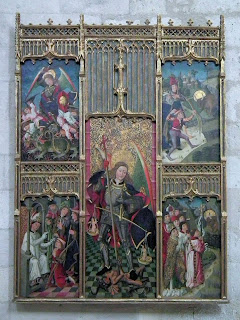 |
exhibit in Diocesan Museum
photo: public domain |
Many other buildings in the city were created in Isabelline style - named after Queen Isabella, it is a most attractive type of ornamentation though rather elaborate. A superb example of this style is the façade of the College of San Gregorio - a flamboyantly decorative building that houses the National Sculpture Museum. It is one of many museums in the Valladolid and includes the Diocesan Museum, which is housed in the Cathedral.
Valladolid Cathedral is a Renaissance building designed by Juan de Herrera in the 16th century. He was the co-creator of San Lorenzo El Escorial, the massive palace-monastery that served as a royal abode and mausoleum - Juan Bautista was the other architect of that World Heritage monument. The Cathedral may not be as spectacular as El Escorial but it is, nevertheless, a decent piece of religious architecture.
 |
Valladolid Cathedral
photo: public domain |
Whilst much of Valladolid is modern, the city has preserved many important buildings especially within its historic quarter. I have mentioned the Cathedral, the University and the museums so let's pay a visit to some of the other sights in the city beginning with the Plaza Mayor. This beautiful square was created in the 16th century and proved to be the model for future plazas in Spain. In the surrounding streets there are many large houses and palaces.
The Palace of the Marqueses de Valverde is most attractive. It was constructed in Florentine style in the 16th-century. The Pimentel Palace is important, historically, because it was the birthplace of King Felipe II. Nowadays, it is the seat of the Provincial Administration. The Palace of Juan de Vivero was built in Gothic-Mudéjar style in the 15th century. It, too, is historically important because Ferdinand and Isabella married there in October 1469. It is currently the headquarters of the Provincial Historic Archives.
 |
Santa María la Antigua
photo: public domain (Floranes) |
The Cathedral is not the only important religious building in Valladolid. The old church of Saint Mary is impressive. Its Castilian name is La Iglesia de Santa María la Antigua and it was originally built in the 11th century. Later a beautiful Romanesque tower topped by a slender pyramid shaped spire was added. This was in the 13th century and it is all that remains of the original church - a Gothic building replaced it in the 14th century. Other important temples in the city include the Monastery of las Huelgas Reales, the Church of San Pablo the Gothic Church of Santiago and the Collegiate Church of Santa Cruz.
 |
San Pablo (old painting)
public domain |
+pd+Mattis.JPG) |
San Pablo facade
photo: public domain (Mattis) |
 |
| Calle de Santiago, Valladolid 1900 |
the above text is an extract from "Spanish Impressions" ISBN 9781445225432
more blogs by Robert Bovington...
"Photographs of Spain"
|
|
"postcards from Spain"
|
|
"you couldn't make it up!"
|
|
"a grumpy old man in Spain"
|
|
"bits and bobs"
|
|
"Spanish Expressions"
|
|
"Spanish Art"
|
|
"Books About Spain"
|
|






+pd+Dariorueda90.jpg)


+pd+Mattis.JPG)
