Follow Me on Pinterest

Friday, October 25, 2013

Almería - the film capital of Spain?

by Robert Bovington

Well, the city of Almería has been used as the location for a number of films including 'Patton' (1969) and 'Never say never again' (1983).


1edb6-almer25c325adaalcazabaoct2004252812529
Almería Alcazaba
The Alcazaba has been used to film Conan the Barbarian,
Indiana Jones and the Last Crusade,and Never Say Never Again


Parque de Nicolás Salmerón Almería
Parque de Nicolás Salmerón in Almería
used as a film location in the films "Patton" and "Lawrence of Arabia"


However, I was thinking more of the province of Almería especially the Tabernas Desert and the Cabo de Gata. Many films were shot here including Sergio Leone's spaghetti westerns starring Clint Eastwood, Lee Van Cleef and others. 'Cleopatra'(1963), 'Lawrence of Arabia' (1962), 'How I Won the War' (1967), 'Conan the Barbarian' (1981), 'The Empire of the Sun' (1987) and 'Indiana Jones and the Last Crusade' (1989) are some of the more well-known films made in this area.


ef02e-almer25c325adafeb20122528122529
Almería - statue of John Lennon
John starred in 'How I Won the War' .
He also wrote "Strawberry Fields Forever" whilst staying in Almería
 
Natural Parks and other protected areas in Spain
Playa Monsul in the Cabo de Gata Natural Park
one of the locations in "Indiana Jones and the Last Crusade"


Tabernas desert Almería
Oasys Theme Park (Mini Hollywood) in the Tabernas Desert (Almería)


sierra de Gador 03
Tabernas Desert - view from the Sierra de Gador
numerous spaghetti westerns were filmed in this area


 more blogs by Robert Bovington...
"Photographs of Spain"
"postcards from Spain"
"you couldn't make it up!"
"a grumpy old man in Spain"
"bits and bobs"
"Spanish Expressions"
"Spanish Art"
"Books About Spain"

Wednesday, October 23, 2013

Mijas

by Robert Bovington


Mijas, a pueblo blanco, is situated in the foothills of the coastal mountain range that overlooks the Costa de Sol. Mijas itself is a typical pretty mountain town but due to it's close proximity to Fuengirola it get's a tad crowded with tourists, even in the winter months. The actual municipal area covers about 140 square kilometres, from the mountains down to the sea and comprises three urban areas, Mijas Pueblo, Las Lagunas and La Cala de Mijas. It is Mijas Pueblo that we and other tourists visit. It is here, the old town with its Town Hall, its historic buildings and its whitewashed houses that holidaymakers seeking a distinct change from the over developed coastal strip are to be found.

My wife likes Mijas because of the shops. Yes, some are a trifle touristy and sell the usual pottery, leather goods and pictures of white-washed houses but there are also more tasteful establishments including shops selling antiques and fine art. There are also the little bars and restaurants some with stunning views. I just like walking the steep narrow streets with the little houses with their white facades adorned by colourful pots of flowers. On one occasion I walked up to the little chapel, the Calvario Hermitage, on the hill high above Mijas. It was rather a strenuous climb and I wished at the time that I had picked a colder day to do it but once there I enjoyed the views and the well-earned rest. Unfortunately the chapel itself was locked.
 

A less strenuous chapel to visit, and one that isn't usually locked, is the Hermitage of the Virgen de la Peña, the patron saint of Mijas. The chapel was built by Mercedarian monks in 1520 and inside is a carved wooden image of the virgin allegedly dating back to AD850. It is a delightful little building, although I find it a bit incongruous that, just like a number of ancient churches that I have visited in recent years, it has electronic candles rather than the real thing! Outside there is a lookout point overlooking the Mijas valley and the Costa del Sol.


Other places to visit in Mijas are the Casa Museo & Carromato de Max museums; the Plaza de Toros bullring and museum of bullfighting. 
 
 
However, my favourite place in Mijas is La Muralla - a park with balconies from where one can view the coast below.


more blogs by Robert Bovington...
"Photographs of Spain"
"postcards from Spain"
"you couldn't make it up!"
"a grumpy old man in Spain"
"bits and bobs"
"Spanish Expressions"
"Spanish Art"
"Books About Spain"

Calar Alto Observatory

 by Robert Bovington

The province of Almería is the sunniest driest place in Spain. It also has the cleanest atmosphere in Europe and hardly any cloud making it an ideal location for installing an observatory.

Calar Alto, at an altitude of 2,168 metres (7,113 feet), is the highest mountain in Almería and was, therefore chosen as the location for an astronomical observatory. Called, appropriately enough, the Calar Alto Observatory, it is owned and operated jointly by Max-Planck institute for astronomy and the Institute of Astrophysics of Andalucía.


It was officially opened in July 1975 with the commissioning of its 1.2 metre telescope. The site has developed due to the strong ties between the German and Spanish owners and 4 more telescopes have been installed - the largest being 3.5 metres.


The Calar Alto mountaintop is situated in the Sierra de los Filabres, north of the town of Gérgal. It is a pleasant place to walk on a summer's day, as the temperature is several degrees cooler than down on the coast.


Calar Alto Observatory site


timepiece at Calar Alto Observatory site

Gérgal (Almería)


more blogs by Robert Bovington...
"Photographs of Spain"
"postcards from Spain"
"you couldn't make it up!"
"a grumpy old man in Spain"
"bits and bobs"
"Spanish Expressions"
"Spanish Art"
"Books About Spain"

al-Andalus

by Robert Bovington

In 711 an army of 7000 under the command of the Berber Tarik-ibn-Zehad crossed the Straits of Gibraltar and defeated Roderic the Visigothic King of Hispania. The Muslim armies swept through Hispania and conquered Toledo which was then the capital of the Visigothic kingdom. This marked the beginning of Muslim domination of a large chunk of the Iberian Peninsula.


The Arabs named this vast region Al-Andalus. Initially it comprised five administrative areas roughly corresponding to Andalucía; Galicia and Portugal; Castile and Léon; Aragón and Catalonia; and Septimania which apparently was where the modern French region of Languedoc-Roussillon is located. So Al-Andalus was pretty big! At that juncture, Al-Andalus was merely a province of the Umayyad Caliphate of Damascus.

Over the centuries, Al-Andalus was ruled by varying Arab dynasties. For example, the Abbasid dynasty assassinated the Umayyads and seized power, and Al-Andalus became a kingdom also known as the Emirate of Córdoba (c. 750-929). Successively it became the Caliphate of Córdoba (929-1031); then a collection of Taifa kingdoms. The last of the Arab kingdoms was the Nasrid kingdom of Granada (1232-1492), which by then was merely the territories of Almería, Málaga, and Granada. This gradual yet massive reduction in the size of this once great kingdom was, of course, due to the Reconquest of Spain by the Christians. Al-Andalus ceased to exist in 1492 when Boabdil surrendered the city of Granada to the Catholic Monarchs.


Córdoba Mezquita
Córdoba Mezquita
Córdoba - statue of Abu al Walid
Granada Alhambra - Patio de los Leones

Alhambra detail
Alhambra detail

more blogs by Robert Bovington...
"Photographs of Spain"
"postcards from Spain"
"you couldn't make it up!"
"a grumpy old man in Spain"
"bits and bobs"
"Spanish Expressions"
"Spanish Art"
"Books About Spain"

Saturday, October 12, 2013

Día de la Hispanidad

by Robert Bovington

Today is another Bank Holiday in Spain - Día de la Hispanidad or Columbus Day.

Why?

Firstly, Columbus was not Spanish - he was an Italian born in Genoa.

Secondly, he is credited with discovering America so we can blame him for the proliferation of fast food outlets like McDonalds.

Thirdly, most of the time he did not know where he was - he thought he was in the Orient when, in fact, he was in Central America.


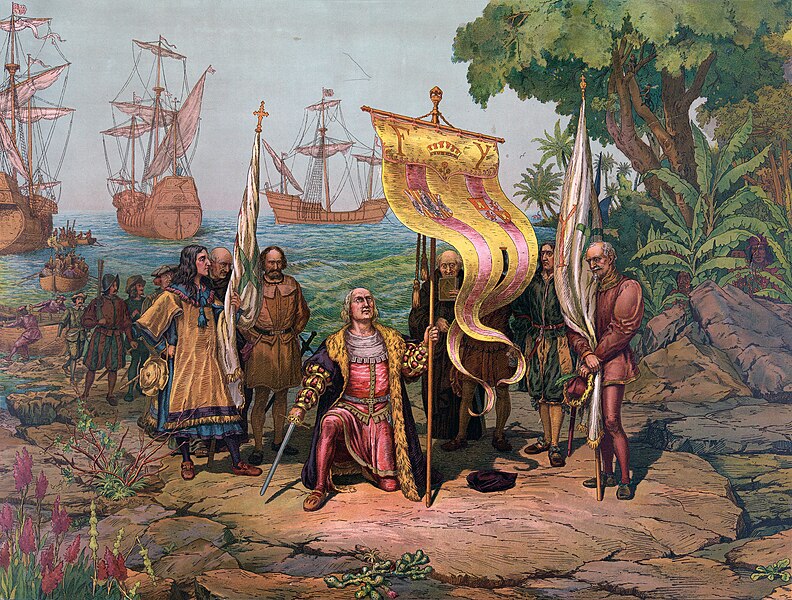
File:Columbus Taking Possession.jpg
Christoper Columbus arrives in America -  L. Prang & Co., Boston

Seriously, though, Christopher Columbus was a famous explorer who, convinced that the World was round when most thought it was flat, persuaded Ferdinand and Isabella to sponsor him on his voyages to the New World. Of course, he did not know it was the New World at the time - he thought that travelling in a westerly direction he would arrive in India. He did not bargain for the small matter that the continental masses of the Americas were in the way!

He set sail on his first voyage on 3 August 1492 in the Santa María. On 12 October he reached San Salvador island in the Bahamas - hence the celebration date. On further trips he discovered Dominica, Puerto Rico, Jamaica, Trinidad and the east coast of Central America including Honduras and Panama.

Columbus was born in Genoa, Italy in 1451.

He spent several years as a mariner in the Portuguese marine. However, he yearned for more status and wished to accumulate riches for his family. He also believed that China and India could be reached by sailing in a westerly direction. Columbus sought sponsorship for his aims and, after a number of rejections, he finally obtained royal support from Spain - King Ferdinand and Queen Isabella agreed to bankroll his first voyage in January 1492.

He made four voyages and we know now that he did not reach India but, instead, discovered America - or part of it! It is widely believed that he was the first European to sail across the Atlantic Ocean and to set foot  on the American continent.

He discovered most of the islands of the Caribbean as well as countries in Central America including Nicaragua, Costa Rica, Panama and Venezuela. He established a base in Hispaniola - an island now divided into Haiti and the Dominican Republic.

Christopher Columbus died in 1506 at Valladolid but his bones were taken to Hispaniola - to the Cathedral of Santo Domingo that is now in the Dominican Republic.


more blogs by Robert Bovington...

"Photographs of Spain"
"postcards from Spain"
"you couldn't make it up!"
"a grumpy old man in Spain"
"bits and bobs"
"Spanish Expressions"
"Spanish Art"
"Books About Spain"